I ♥ systems
I’m fascinated by systems because of how empowering they can be. Building systems can be a monumental task, describing the myriad interesting ways in which any given moment could play out.
Most of my systems design work has been during pre-production, so I don’t have much to share in terms of publicly available work samples. However, I’m happy to talk about the type of work I’ve done.
Innovations in Immersive Gameplay

Voice-Activated Dialogue Interactions
Working at Ready At Dawn (RAD) was an amazing opportunity to explore narrative design at the cutting edge of gaming and development technology. Like many gamers, I’ve dreamt of being able to speak to my favorite characters and to feel like they’re really talking back to me. Speech recognition tech is improving, but problems remain, such as the accurate handling of diverse accents and latency during processing.
Driven to bring my voice into the game, I prototyped a few experimental systems – in both RAD’s proprietary engine and our custom implementation of Unreal Engine 5 – that found compromises between the traditional dialogue choice wheel and the life-like speech recognition we all dream of. Thanks to my prototypes, I was able to prove that when an NPC responses to your actual voice, it does indeed feel like being truly immersed in the virtual reality of the moment.

Newbie- and Party-Friendly Action Controls
At Telltale Games (before its closing and subsequent revival), stagnation was a concern. Our style had become so predictable that the community had begun referring to “the Telltale formula” to describe their gameplay experiences.
Although I wasn’t yet officially a designer, I took it upon myself to prototype and pitch novel systems to help us grow as a company. For instance, for games that focused more on combat, I devised a system wherein the game controller could be used more reactively, requiring zero familiarity with button labels, which would allow for even complete newbies to join in on the fun.
Tool Development
Working Smarter, Not Harder
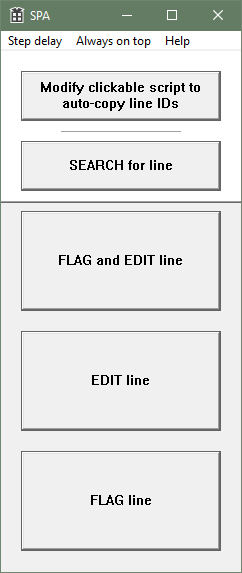
Back before I became a designer with official engineering support, if I wanted specialized tools, making my own was often my only option. My Subtitle Pass Assistant tool, for example, was all about saving clicks and keypresses.
As a Creative Development Assistant (CDA) at Telltale, a lot of my time was spent proofreading and processing dialogue scripts – e.g., fixing spelling errors, and flagging lines that needed special attention from the automated lipsync system. Unfortunately, this work was needlessly cumbersome due to a lack of task-specific tools. After consulting with senior engineering staff, I set about solving this efficiency problem by writing a tool of my own in C++.
Now, instead of digging through multiple menus every time a line needed attention, the CDAs (of which there were several) would only need a couple clicks, thereby greatly increasing our efficiency.